
Strip Light Running Costs: 3 Money Facts
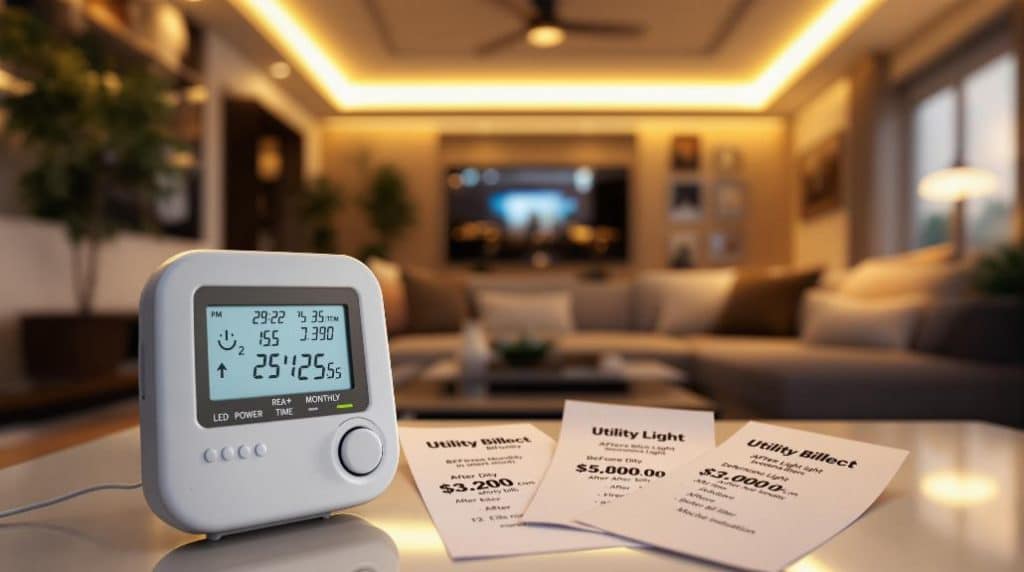
When you think about strip lights, here are three money-saving facts that'll make you smile. First, LED strip lights consume about 85% less energy compared to old-school incandescent bulbs. Imagine saving on your electric bill! Next, calculating running costs is a breeze. Just multiply wattage by hours used, and voilà! Finally, these lights can last over 50,000 hours, meaning fewer trips to the store for replacements. Over time, you could save up to £1,392—now that's what I call a win! Stay with us, and you'll uncover even more tips to brighten your space without dimming your wallet.
Key Takeaways
- LED strip lights consume significantly less energy, saving up to 85% compared to incandescent bulbs.
- Daily running costs for a 16.4-foot LED strip can be as low as £0.17 when used for six hours.
- LED strips last over 50,000 hours, reducing replacement costs and time spent on maintenance.
- Transitioning to LED technology can yield an ROI of approximately 141.87% when upgrading from fluorescent lights.
- Total savings from using LED strip lights can reach about £1,392 over 30 years.
Energy Consumption Comparison
When comparing energy consumption between LED strip lights and traditional lighting, you'll find that LED technology greatly outperforms older options.
For instance, a typical 60-watt incandescent bulb gobbles up about 600 watt-hours over ten hours, which is quite a lot! In contrast, an equivalent LED strip light uses only 90 to 120 watt-hours in the same time frame. That's a staggering difference!
Now, if you think fluorescent lights are decent, think again. They're more efficient than incandescent bulbs, using about 180 watt-hours for an 18-watt bulb.
But they still can't match the efficiency of LEDs, which can save you up to 85% in energy compared to those old-school incandescent bulbs. Imagine what you could do with all that savings!
LED strip lights not only chew up less power, but they also contribute to lower electricity bills and a smaller carbon footprint.
So, whether you're lighting up a cosy reading nook or adding ambiance to a party, choosing LED strip lights means you're making a smart, eco-friendly choice.
Who knew saving the planet could be so bright and budget-friendly?
Cost Calculation Breakdown
Understanding the running costs of LED strip lights involves breaking down several key calculations. First, you need to figure out how much power your strips consume. Just multiply the watts per metre by the total strip length. That'll give you the total power consumption. Don't forget to determine the number of LEDs per metre too!
Next, when selecting a power supply, make sure its wattage is at least 20% higher than your total strip wattage. A good rule of thumb is to calculate the minimum power supply size using the formula: length × watts per foot × 1.2.
Now, for the fun part—calculating the daily cost! Multiply your total wattage by how many hours you use the lights, and then by your electricity rate. For example, if your strip consumes 24 watts and you use it for 6 hours a day, at £0.12 per kWh, your daily cost would be around £0.043.
Simple, right? Just remember to convert that daily cost to monthly by multiplying it by the number of days in a month. Happy lighting!
Long-Term Savings Analysis
As you consider the long-term savings of LED strip lights, you'll find that their impressive longevity and energy efficiency can lead to substantial financial benefits.
Imagine this: while incandescent bulbs give you around 2,000 hours of light, LED strips can shine brightly for over 50,000 hours. That means fewer trips to the store for replacements, saving you both time and money.
Now, let's talk about energy efficiency. LED strips use a whopping 85% less electricity compared to incandescent lighting.
Picture your electricity bill—those savings can really add up! If you're using a 16.4-foot LED strip for just six hours a day, you could save about £5.18 a month.
Over 30 years, those savings can reach approximately £1,392!
And with an impressive ROI of around 141.87% when upgrading from fluorescent lights, it's clear that making the switch is a smart move.
You're not just investing in lights; you're investing in a brighter, cheaper future.
Conclusion
So, there you have it! Understanding the running costs of strip lights can really make a difference in your wallet. By keeping an eye on energy consumption and calculating those costs, you can save money in the long run. Plus, who doesn't love a bright, stylish space without the hefty price tag? So go ahead, light up your life without breaking the bank—your future self will thank you for it!